
1.820.3345.33
Contact@TravelTourWP.com


One of Windhoek’s best known monuments is Christ Church. This Lutheran church was designed by architect Gottlieb Redecker and has become a landmark in Windhoek. Following the wars between the Germans and the Herero, Owanbo and Khoikhoi, the foundation stone was laid on the 11 August 1907. Originally the church was known as the “Church of Peace”, and was officially dedicated on the 16 October 1910.
In January 1886, the German Lutheran Congregation was founded. Not having a church at the time, the members used to congregate in the church hall of the parsonage. They had always had the idea to build their own church and purchased the land they needed in 1898. By 1900 a government architect had drawn up the plans, but due to the wars at the beginning of the century, the project was put on hold.
Eventually, in 1907, building commenced on the church that was going to be called the Church Of Peace, as it symbolised the peace after the war. The site for the church was on a hill so that it was visible from far away. At a cost of 360 000 German Marks, double the original amount, the church was completed. The architect also supervised the building.
The only material used from the area was sandstone that was mined in the vicinity. A small railway line was built especially to transport this material to the construction site. Carrara marble was imported from Italy for the portico. From Germany, they shipped in the roof supplies, clock and other material that was needed. German Emperor Kaiser Wilhelm donated three stain glass windows.
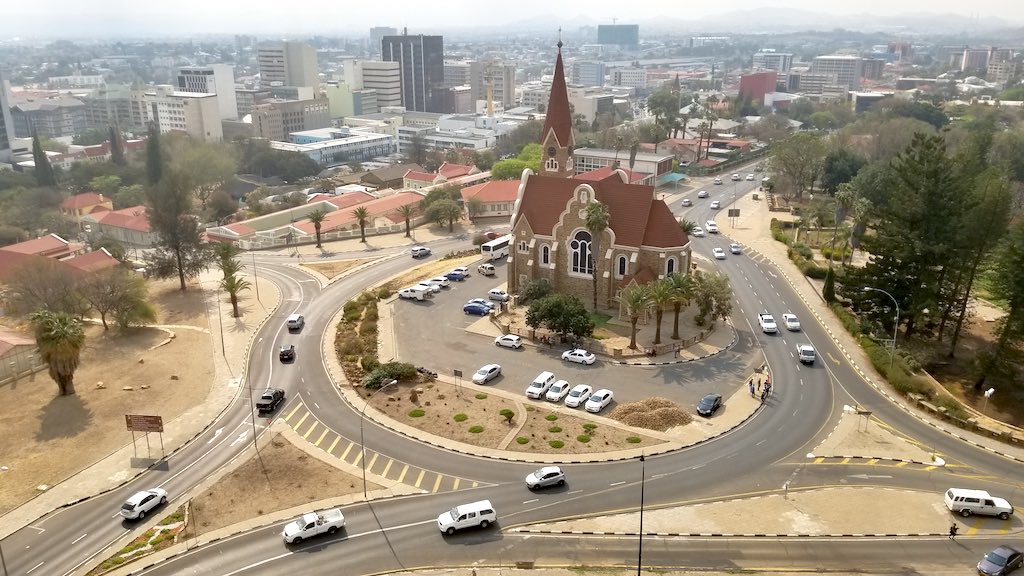
The church has a 42-metre high tower that is topped with a Gothic Spire even though the church has been built in a neo-Romanesque style. The church has three bronze bells that are inscribed; Ehre sei Gott in der Hohe”, “Friede auf Erden” and “Den Menschen ein Wohlgefallen”, meaning Glory to God, Peace on Earth and Goodwill towards Men.
The altarpiece was a copy of Rubens’ famous “Resurrection of Lazarus”. This was moved to a gallery in later years and a copy was donated by the wife of Governor Seitz before World War One. Unfortunately the original was destroyed in Berlin in 1945.
From 1967 to 1972 the whole church was renovated, with even the original corrugated roof being with tiles. Inside the church, on the walls, you will find a bronze plaque with the names of the German soldiers, marines and even civilians that lost their lives fighting during the Herero uprisings of 1903 – 1907.
***