
1.820.3345.33
Contact@TravelTourWP.com


Most of Namibia’s architecture resembles the German style and this is due to the fact that Namibia was colonized by Germany as far back as 1884. It is therefore no surprise that when you are exploring Kolmanskop, you might just feel as though you are in a German town rather than in the heart of Namibia’s tourist attractions.
Kolmanskop was founded in 1908, when Zacherias Lewala, a railway worker that was shovelling drift sand from the tracks and happened to find some interesting looking stones. A permanent-way inspector on the line was a former employee of DeBeers and he took the stones to Luderitz for further inspection. They were diamonds.
With high hopes of getting the big one the German miners quickly settled in the area. Kolmanskop grew swiftly as a mining town and soon it had 1 700 residents. The total worlds diamond production is said to have being mined in Kolmanskop in 1912. Due to the wealth of the mine, the miners purchased every luxury they could afford to keep themselves comfortable in the harsh and isolated town and they built elaborate houses.
The residents of the town enjoyed all kinds of comfortable amenities including a hospital, where two German doctors were employed and the first x-rays station in the southern hemisphere was located, a ballroom, a power station, a casino, a swimming pool and a sports hall. They also had a local butcher and baker. Entertainment came in the form of opera companies from Europe that were shipped in at the expense of the mine. The opera hall was designed and the building supervised by a German expert that was also brought in and paid for by the mine.
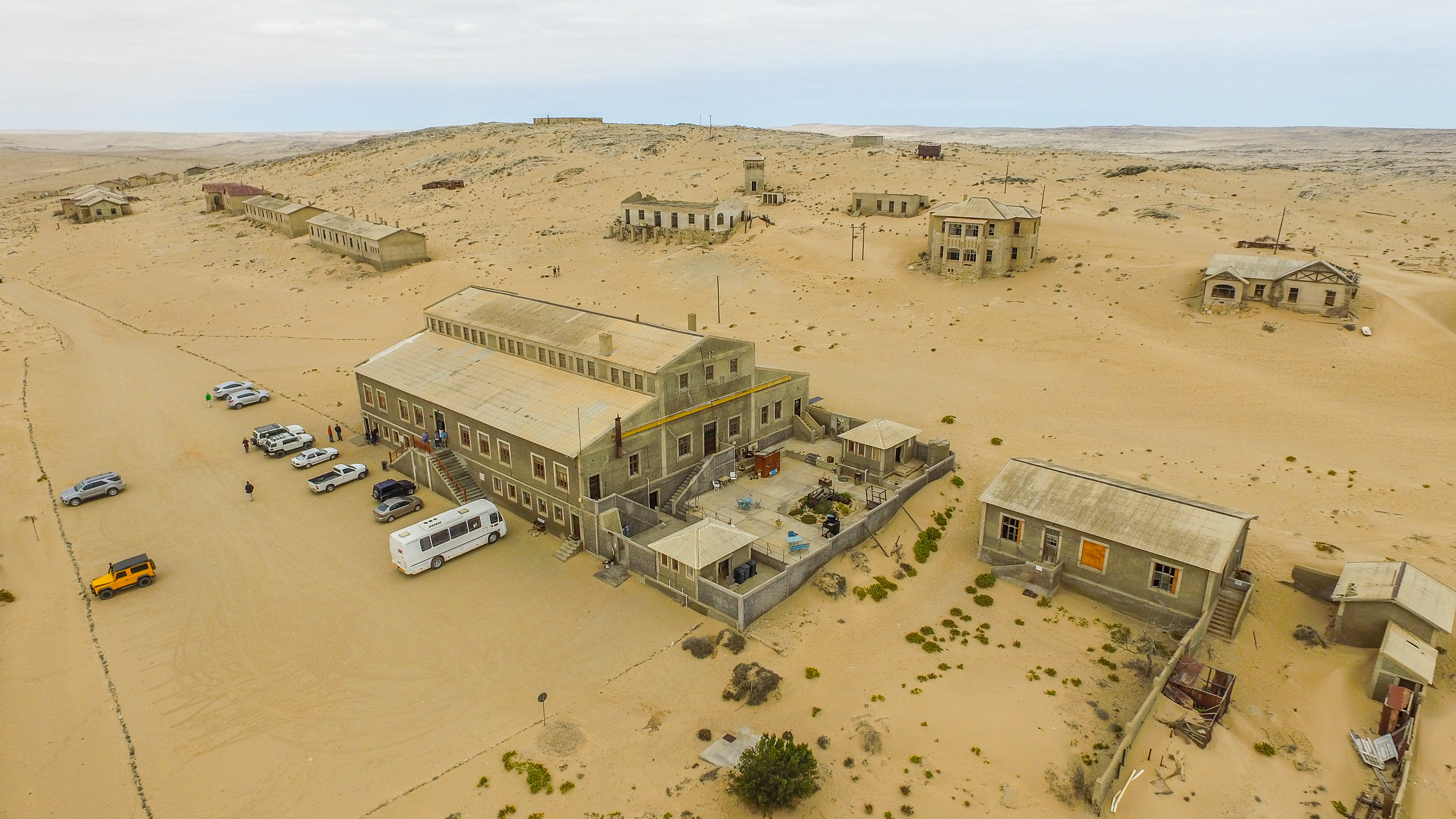
The town back then was lush with sprawling gardens, rose beds and manicured lawns. All this was made possible by bringing fresh water by rail from 120 km away.
The first tram in Africa came to Kolmanskop, and it linked to the coastal town of Lüderitz. The diamond mine paid for plenty rewards for more than ten years.
Sadly by the end of World War 1 the mine was showing signs of being exhausted. After nearly 50 years, the once thriving diamond mining town of Kolmanskop was all but deserted in 1954, with many of its inhabitants leaving behind not only their possessions but also their homes to fight a constant battle against sand storms and the harsh elements of the desert. Most of the miners moved swiftly south to where some of the richest diamond bearing deposits ever know were discovered.
Today, after 60 odd years of abuse by Mother Nature, the small mining town of Kolmanskop has almost being reclaimed by the sand dunes. Since most of the doors and windows have long since been blown out and the metal screens rusted away, most structures in Kolmanskop are filled with desert sand.