
1.820.3345.33
Contact@TravelTourWP.com


Twyfelfontein, known to the local Damara as “Jumping Water”, is a World Heritage Site. The district where this World Heritage Site can be found is in a valley in the Damara Highlands about 70 km west from Khorixas in the Kunene region. This area receives very little rain, but has a spring in a valley that consists of sandstone slopes.
About 6000 years ago the site was inhabited by hunter gatherers. In later years the area was the home of the Khoi Khoi herders. It was used by both the hunters and the herders as a place of worship or a site to conduct shamanist rituals. 2500 rock carvings and also a few rock paintings are all that remains of this by-gone era.
After World War II a severe drought brought white farmers to the region, where they remained until 1965, when they left after the area was procured by the government in order to include this part of the land in the Damaraland Bantustan.
Engravings on the rocks in the area were chiselled through the outer layer of rock, exposing the lighter rock underneath. The engravings on the rocks were made over thousands of years, some dating back 6000 years. There are three distinctive different kinds of engravings in the area:
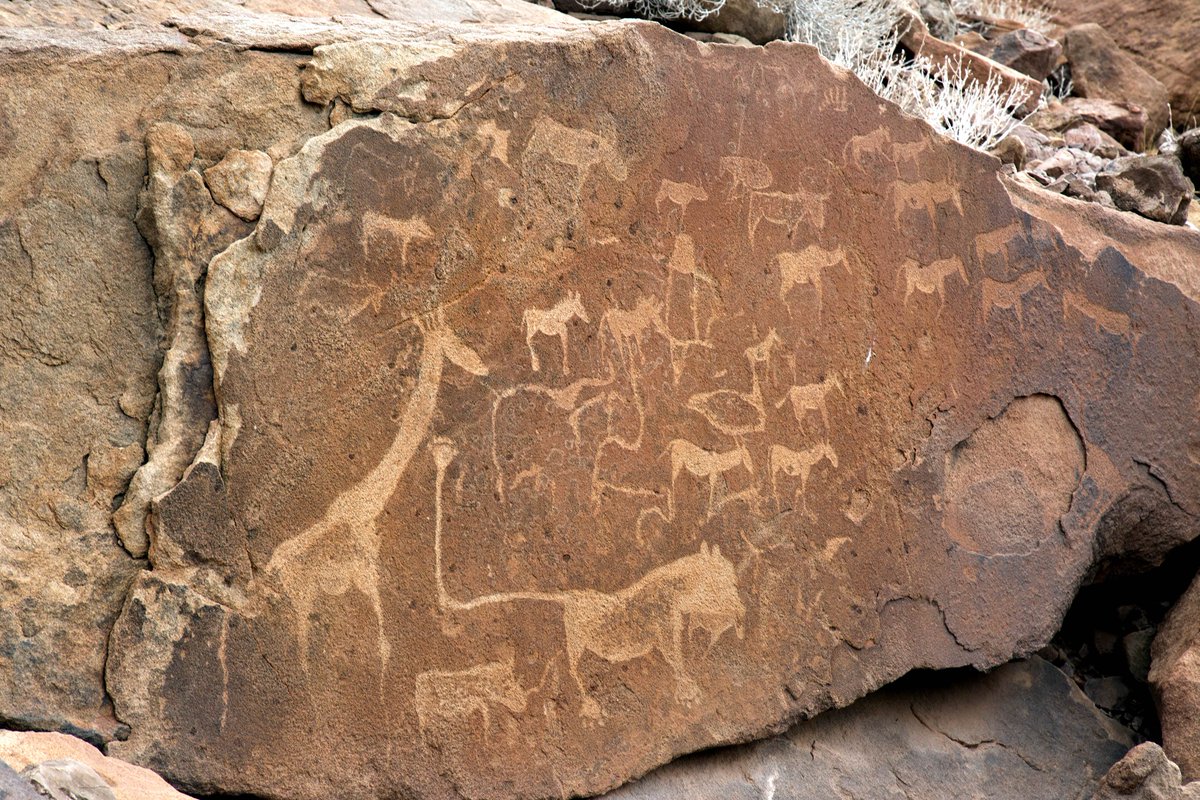
The rock art was probably made by the early hunter-gatherers in the area. Most of the rock art consists of animals which include ostriches, giraffe, elephant and even rhinoceros.
A famous painting is that of the “Lion-Man” which is a distinctive looking lion but with a long rectangle tail that is kinked in the middle and ends with six toes. This is said to depict the transformation of man to animal. This along with the painting of animals and their tracts makes it believed that these images form part of the shamanist rituals. It is believed that these early hunters must have had contact with hunters as far away as 100km, as they also painted penguins and flamingos.
Many Stone Age objects were found in the area. Of the objects that were found there was a wide variety of stone tools, which were made from quartzite. The shape of some of these tools indicate that they were not all used for rock art, but also for use in wood work and leather work. Among the other objects found in the area were delicate pendants and beads, many made from ostrich eggshells. On excavating of the area, everyday objects such as charcoal and bone fragments were found.
To prevent people from stealing the rock engravings, the valley was declared a National Monument in 1952 and can now only be visited with a local guide.