
1.820.3345.33
Contact@TravelTourWP.com


Not far from Grootfontein in Namibia, in the Otjozondjupa Region, you will find the farm Hoba. This is not just any farm, this is home to the Hoba Meteorite. The Hoba Meteorite lies where it fell, with its tremendous weight keeping it firmly in place.
This 60 ton meteorite is the largest known meteorite in the world, outweighing the 37 ton meteorite that can be found at Campo Del Cielo in Argentina. On top of this, it is also the largest naturally occurring piece of iron on the Earth’s surface. The name Hoba comes from the Khoekhoegowab word that simply means “Gift”.
The rock was first discovered by a Mr Brits. The original report by Mr Brits of how he discovered the meteorite can still be viewed in the museum in Grootfontein, Namibia. It reads as follows:
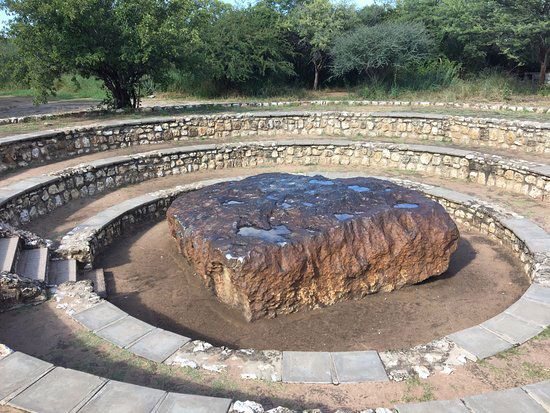
It is estimated that Hoba made impact with Earth less than 80 000 years ago, with the meteorite itself being about 200 million years old. At the time of impact it is thought to have weighed about 66 tons, but due to erosion, scientific sampling and vandalism over the years, its weight is today estimated at 60 tons.
When Hoba entered the Earth’s atmosphere it slowed down making it cause minimal damage to the earth’s surface and leaving the meteorite intact. Hoba is an unusual meteorite as its largest surfaces are flat. This body of metal is made up of iron, nickel and cobalt and measures a staggering 2.7×2.7x.9 meters.
The Hoba Meteorite was declared a National Monument in 1955 after the American Museum of Natural History was unable to move it in 1954 (the owner of the farm at the time gave permission for it to be declared a National Monument in an attempt to minimise the vandalism of the meteorite). 25 x 25m of land around the meteorite was included with it, and the entire area was declared a monument in 1979. The whole site of the meteorite was donated in 1987 for educational purposes.
Today the area is a tourist centre and one of Namibia’s popular destinations, with grass, a picnic area and easy access to the meteorite. It is visited by thousands of people every year and because the meteorite is protected, the vandalism of this treasure has ceased.